Wednesday, August 3, 2016

13 Weeks of Summer... An Adventure Every Week!

Summer is here, but it won't last long! Celebrate each week by going on a dog-friendly outing. 


Adventure #4 of Summer...

Doggie Date Night @ Fred's Mexican Cafe

"Its a Patio Party for your Pup"

Cool down, and cheer up after a long day at work, with a nice meal down in Huntington Beach. At Fred's Mexican Cafe, every Monday is Doggie Date Night; and your pups gets a free doggie dinner when you buy an entree. 

The chance for some doggone good eats begins at 6 p.m. and goes until Midnight. 
300 Pacific Coast Highway
Huntington Beach, Ca

Doggie Date Night: 6:00p.m. - 12:00 a.m.


Adventure #5 of Summer...

Visit L.A. for a day!


There is lots to see and do in Los Angeles. And despite the popular belief that 'No Body Walks in L.A.', there are plenty of pedestrian-friendly excursions for you and your dog. 
Be a Tourist - Take a stroll down the Hollywood Walk of Fame, and see if you can spot any stars belonging to famous dogs. Then, stop at the Chinese Theatre and see if your paws fit anyone famous (there are famous animal prints there too). 


Be Active - Hike to the Hollywood sign. There are a few trail options, ranging from easy to difficult, depending on your comfort level. The trails are open from sunrise to sunset, same hours as the Griffith Park (since they are all part of the park).


Be a Foodie - Find a food truck or an outdoor patio at a restaurant and grab some grub with your pup. You can enjoy some people watching and take in the sounds of L.A.


Adventure #6 of Summer...

Enjoy Some Sweet Sounds
With summer in full swing, it’s hard to keep cool during the day, which makes you want to stay inside. But there is an upside to these hot days, which are those perfect summer nights. 
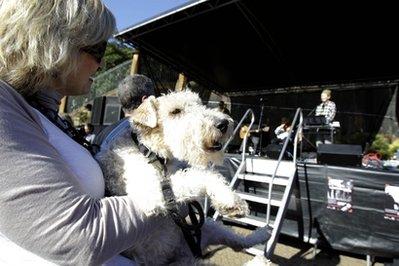
If it’s too hot to enjoy the day with your pup, spend an evening with him or her instead.  Most cities have a free summer concert series in the park, during the week.

From classical to classic rock, country and more; you and your pup are bound to find music that you enjoy.

Some of the local parks and line ups include:
Anaheim
Ronald Reagan Park

945 S. Weir Canyon Rd. 


Concerts in the Canyon Held on Thursdays 6:30 p.m.
Band Line-up: 
July 14: 80z All Stars (Complete tribute act)
July 21: Born Jovi (Tribute to Bon Jovi)
July 28: The Petty Breakers (Tribute to Tom Petty)
August 4: DSB (Don't Stop Believin')(Tribute to Journey)


Fullerton

Fullerton Sports Complex

560 E. Silver Pine


Concerts are Wednesdays, 6:30 p.m. to 8:30 p.m.

Band Line-up:

July 13: U2Experience (U2 Tribute)
July 20: Jann Browne Band (Country)
July 27: Skynyrd Reloaded (Leonard Skynyrd tribute)
August 3 : Stone Soul (Motown & Soul)
August 10: The Answer (Classic Rock)


Placentia
Tri City Park
2301 N Kraemer BLvd.

Concerts are Thursdays at 6:30p 

Band Line-up:
July 7: Diamond is Forever (Neil Diamond Tribute)

July 14: Upstream (Steel Drum, Reggae, Calypso)
July 21: The Fenians (Traditional Irish Folk & Rock n Roll)
July 28: Darden Sisters (Variety - Country, Swing, Jazz, Western)
August 4: Smokin’ Cobras (Rocking Oldies)
August 11: Mariachi Divas (Award Winning All Female Mariachi)


Orange
Hart Park Bandshell
701 S Glassell St.

Concerts are Wednesdays, 7:00-8:30 p.m.

Band Line-up:
July 6: Stone Soul (Motown & Soul)
July 13: The trip (Classic & Modern Rock)
July 20: Kelly Rae Band (Country)
July 27: Tom Nolan Band (R&B & Soul)
August 3: Wiseguys (Big Band)
August 10: Cold Duck (R&B & Dance Favorites)
When you go, don’t forget a blanket and or lawn chair for you and your pup to sit on.  And most importantly, don’t forget your petiquette while enjoying the concert.  Remind your pup to be on his best doggy behavior at all times.  Keep him on his leash, be sure to pick up any messes he leaves, and bring plenty of fresh water for him.  


Adventure #7 of Summer...
Dog Days at the Fullerton Market

The Fullerton Market is a favorite among locals, and rightly so.  Operating weekly, the market offers fresh produce, prepared foods, arts and crafts, jewelry, novelty and gift items, live entertainment, kid’s activities, and a beer garden.   


This Thursday, August 4th, you and your dog can experience the market for yourself as the Fullerton Museum Center Association hosts Dog Days at the Fullerton Market. 

Dog Days at the Fullerton Market is a great opportunity to not only get a taste of the Fullerton Market, but also to join in the camaraderie of the dog community; giving you the chance to interact with other dog lovers and dogs alike.  You and your dog can join in the fun of one of the dog contests, like loudest bark or fastest eater, or simply enjoy a short dog show.  Whatever you decide to do, this special dog market will feature many dog-related vendors and activities to make sure you and your dog have a good time.    

The fun takes place this Thursday, August 4th, 2016 from 4:00 p.m. – 8:30 p.m. at the Downtown Fullerton Plaza located at 125 E. Wilshire Ave., in Fullerton.   

And even if you can’t make it to the market for this special event, you can add it to your list of adventures to try on a different week.  The market is open every Thursday from April to October.

Adventure #8 of Summer...
Cool off at Huntington Dog Beach

One of the best places for a dog to be a dog is romping through the sand and splashing in the water at the Huntington Dog Beach.  Even if your dog doesn’t like the water, playing on the sand is a better workout for him them walking on concrete.  
The dog beach can be found at the very end of Goldenwest Street in Huntington Beach (around lifeguard tower 24).  The dog beach stretches from Goldenwest Street to Seapoint Street (to the right of Goldenwest when facing the beach from PCH).  There is metered parking along PCH or free parking one to five blocks inland, among the homes.  Check out the Huntington Dog Beach website for a list of beach rules and other FAQs.  

Don’t forget to bring poop bags, a towel, fresh water for your dog, and sunblock if your dog requires it.  If it is your dog’s first time at the beach don’t be afraid to take it slow.  You want his first experience to be positive so you can come back again. 


Stop for a Bite at the Park Bench Café…
After a good run at the beach, your pup should be tired.  A tired dog is a good dog, so it’s the perfect time to stop in at the Park Bench Café for a bite to eat.  

Located at 17732 Goldenwest Street, in Huntington Beach, the Park Bench Café is a one of a kind stop for dog lovers who want to enjoy food and the beautiful outdoors with their four-legged friends.  

After you order one of their delicious menu items for yourself, be sure to get something for your dog off the dog menu.  Your pooch can get a hot dog (without the bun), chicken, ground beef, bacon, lean ground turkey, and even eggs.  Check out the Park Bench Café website for a complete menu and list of dog rules to make sure your first visit there goes smoothly.   And if you have the energy after eating, you and your pup can saunter around the beautiful surrounding park before heading home.


Adventure #9 of Summer... 
Watch a Movie under the Stars...
 
Enjoy the summer night air, under the stars, watching a movie in the park with your pup.   Find a nice spot on the grass, lay out a blanket and a lawn chair, and get cozy. A lot of different cities offer movies in the park from June through August.  In the 9th week of summer, you can catch one in Yorba Linda, or one in Tustin, or both!

The Good Dinosaur
Friday, August 19, 2016: 7:45 PM - 9:45 PM
Location:
Hurless Barton Park
4601 Casa Loma Avenue
Yorba Linda, California, 92886


Kung Fu Panda 3
Thursday, August 18, 2016: 7:50 PM - 10:00 PM
Location:
Frontier Park
1400 Mitchell Avenue
Tustin, California, 92780

Don’t forget to bring snacks for the humans, and water for your dog.

Thursday, April 7, 2016

Beating the Rainy Day Blues

With rain in the forecast, you may find your dog feeling a little pent up. Especially if he or she refuses to go out in the rain.  

Here are a few simple solutions to avoiding the rainy day blues for your dog:

Food Puzzle – You may consider ditching the customary food bowl and give him a puzzle feeder in\stead.  This will keep him distracted for a bit while stimulating his mind. 

Obstacle Course – Build an obstacle course around the house (or in 1 room) and help your dog jump, crawl, and wiggle their way around for treats.  No need for fancy equipment.  Put a broom stick across two chairs, where he can jump over or crawl under.  Have him weave between stacks of books. Whatever you build or create, make sure it’s making him think a little.  

Hide & Seek – Always a favorite game for dogs because it involves you and treats.  And it’s a good lesson in recall.  Have your dog wait in one room while you hide in another.  Call his name and see if he can find you.  A treat for him when he does! (You may need help having someone to stay with him a room while you hide)

Doga – If you want to bring a little Zen into your lives, while you listen to the sound of rain outside, you can do yoga with your dog. Check out DogaDog.com for videos on how to incorporate your pup in your yoga routine. 


Treadmill – If you have a treadmill laying around, that you swear you’re going to use again one day, now is the time to do so. If your dog is already used to walking on a treadmill, great! You have it easy, and your dog will thank you for the much needed exercise.  If you have never walked your dog on a treadmill, check out this tutorial video, or look for a training video that works best for you.


Dog daycare – Of course, Dachs 2 Danes dog daycare is an option. They get to play all day with other dogs, while getting minimally wet, and you get to enjoy the benefits of a tired dog at night. So you can go home and curl up in a blanket with a book. Ii's a win-win!    


Tuesday, March 15, 2016

The Scary Truth about Giardia and the Importance of Fecal Exams


As you may, or may not, be aware, we ask that dogs who participate in daycare at Dachs 2 Danes get a yearly fecal exam.  It never ceases to amaze me how many people have never even heard of a fecal exam before they come to us. This tells me that most vets are not letting patients know what a fecal exam is, and why it is important; especially for puppies and socialized dogs.

Not all puppies are born with worms. However, it is so common for puppies to be born with Roundworm and Hookworm that most puppies get de-wormed as a precaution.  While Tapeworm is the parasite you can actually find in a dog’s feces (which looks like dried-up rice), Roundworm, Hookworm, and Whipworm are not usually visible to the naked eye. What does this mean for your dog? He can be infected and you don’t even know it.

While worms are gross and scary to think about, we want to talk more about a parasite that isn’t talked about very often. That parasite is Giardia.

What is Giardia?

Fancy Answer: Giardiasis is an intestinal infection of man and animals caused by a protozoan parasite Giardia intestinalis (also known as Giardia lamblia).

Simple Answer:  Giardia is a simple one-celled parasitic species; it is not a "worm", bacteria or virus.  

How does a dog contract Giardia?

Long Answer: “A dog becomes infected with Giardia when it swallows the cyst stage of the parasite. In susceptible dogs, once the cyst passes into the dog's intestines; it goes through transformation to the trophozoite or feeding form and attaches to the intestinal wall to feed.  Trophozoites reproduce by dividing, and some transform into the cystic form. Eventually, the dog passes cysts in its stool.
These cysts are immediately able to infect another animal. Giardiasis can be transmitted by eating or sniffing the cysts from contaminated ground, or by drinking contaminated water.
When Giardia cysts are found in the stool of a healthy adult dog without diarrhea, they are generally considered a transient, insignificant finding. However, in puppies and debilitated adult dogs, they may cause severe, watery diarrhea that may be fatal if left untreated.” – VCA Animal Hospital

Short Answer:  "Giardiasis can be transmitted by eating or sniffing the cysts from contaminated ground, or by drinking contaminated water."

What are the symptoms of Giardia?

Long Answer: “These microscopic parasites attach themselves to the intestinal wall, and the damage causes an acute (sudden-onset) foul-smelling diarrhea. The stool may range from soft to watery, often has a greenish tinge to it, and occasionally contains blood. Infected dogs tend to have excess mucus in the feces. Vomiting may occur in some cases. The diarrhea may be intermittent. The signs may persist for several weeks and gradual weight loss may become apparent.  Most dogs do not have a fever but may be less active.” – VCA Animal Hospital

Short Answer: Giardia can cause a foul-smelling diarrhea that may range from soft to watery. It often has a greenish tinge to it, and may, on occasion, contain blood. The infected feces also tends to have an excess of mucus. Vomiting may occur in some cases.

How is it Diagnosed?

Fecal floatation exams are meant to catch parasites in the stool. Detecting tiny Giardia cysts requires a special zinc sulfate floatation solution. Unfortunately, because Giardia cysts are shed inconsistently in the feces, infection can go undetected.  But stool samples can be analyzed for the presence of Giardia specific antigens (cell proteins), if an infection is suspected. Many cases are diagnosed on the basis of medical history and clinical signs suggestive of Giardia.

How is it treated?

“The most common drug used to kill Giardia is metronidazole, an antibiotic. It is normally given for five to seven days to treat giardiasis. Another anti-parasitic drug, fenbendazole, is suggested as a potentially useful treatment, especially when used in conjunction with metronidazole. Some dogs may require follow-up tests and treatments based on their condition and severity of infection.” -VCA Animal Hospitals

Will my dog be alright?

The disease is not usually life threatening unless the dogs' immune system is immature or immunocompromised. 

What Dachs 2 Danes does to combat contamination?

  • Yearly Fecal Exam: Because dogs can be a carrier of parasites without showing symptoms, we ask for a fecal exam to be done at least once a year.
  • Poop Pick up: Picking up poop promptly, then sanitizing the immediate area.
  • Nightly Sanitization: We clean the daycare nightly (inside and out) with Triple Two, a product that cleans, kills, and prevents bacteria growth.  This cleaner works to fight Kennel Cough, Canine Distemper, Rabies Virus, Avian Influenza, Hepatitus, Coccidia, Giarrdia, and more. 
  • Open Communication: We will let you know if we notice any unusual changes in your pup. We ask that you please let us know if your dog has been diagnosed with Giardia or another parasite. If he/she has, we ask that they stay home until they are parasite free (i.e. after treatment and a clean fecal exam).

What I can do to prevent my dog from contracting a parasite?

  • Watch out for poop: If you see poop while walking your dog, avoid it. Don’t let him stop to sniff, even if he tries to pull you to it.  A dog can pick up several contagious viruses and unwanted parasite “eggs” just from sniffing.
  • Watch out for fleas: Fleas are common carriers of worm eggs. Dogs can contract worms by ingesting contaminated fleas. 
  • Watch out for water: Most humans contract Giardia by inadvertently drinking contaminated water.  If you take your dog to the river, lake, or hiking where there is water (such as a stream) don’t let your dog drink from the water.  Always bring fresh water for you and your dog to drink.
  • Regular fecal testing: Get a fecal exam done every six months to a year. Make sure they are testing for worms AND giardia. Also, research has found that the results for fecal exams sent out to a lab to be tested are 20% more accurate than fecal exams done in-house by your vet’s office. So make sure your vet sends samples out to be tested.


We want everyone to enjoy their socialization experience, without having to worry about bringing home extra, unwelcome guests.  Please help us in this effort by getting regular fecal exams. 

Wednesday, January 13, 2016

Resolution: Teach an Old Dog Owner New Tricks


The Association of Pet Dog Trainers (APDT) officially made January ‘National Train Your Dog Month’. And it doesn’t hurt that it coincides with New Year’s resolutions as well (for those not so new pet parents that need to take a different approach on training).  

Training a dog is a very important part of responsible dog ownership.  And while we all think it’s a no brainer not many owners realize that they have replaced training with extra love and treats.  Then, when the dog does something bad, he gets screamed at and possibly punished, but the bad behavior is never corrected and he never understands what he did wrong, so the bad behavior continues.  To avoid these incidents, a dog should begin his training as soon as he comes home with you, puppies included. 

As Cesar Millan, and any other trainer will tell you, dogs live in the now (the present).  They aren’t thinking about the life they use to have before you adopted them, or how they got in trouble last week for digging; all of that is in the past.  So, the first step to getting a well-behaved dog is to change the way you think about your dog. Think about your dog in the present.  What is he?  Is he a child? Is he a war veteran? Is he a nurse?  No, he is a dog.  While he may depend on you like a child, may have been rescued from an abusive home, and may stay by your side while you are sick, none of that matters in the present.  Those are experiences that have happened in the past and not the dog that stands in front of you today. 

I know a lot of pet parents do not believe that their dog’s past life does not affect him.  But I can tell you from experience, it only affects your dog because you hold on to it, not because your dog does.  If you want to see real changes in the way he behaves, you have to let go of his past and start from scratch. Sometimes dogs do become psychologically skewed (and not just from abuse) and that damage needs to be undone before you can move forward.  So, if you want your dog to become the perfect model citizen (which you should) then you have to be willing to put in the time, energy and effort it takes to go back to the basics. 

1.       Needs - Let’s start with basic needs.  When a dog’s basic needs are brought up in conversation most people automatically think food, water, shelter.  And while those answers are correct, most people do not think of another basic need, which is psychological.  Dogs need a purpose.  Whether it’s hunting, giving protection, or companionship, dogs need something to focus on and succeed at.  Acknowledging that basic need and combining it with a dogs drive to please their human will result in much more successful training sessions. 

2.       Attention - As you get ready to start your training session, keep your dog’s attention span in mind.  If you want your dog to succeed, keep each training session short and sweet.  Most dogs can’t learn to (or retain the commands for) sit, shake, and rollover in the same day.  And if you want reliable obedience then you need to be repetitive and patient.  Most dogs can give you their focused attention for 10 – 15 minutes. 

3.       Abilities - Remember that all dogs are different.  Some abilities, like retrieving, may come easier to a Labrador while other abilities, like sprinting, come more naturally to a Greyhound.  The pace at which your dog learns a command does not matter.  All that matters is the end result, which should always be the mastered command. 

4.       Consistency - The key to successful training is consistency, consistency, consistency!  All too often owners get frustrated and give up on their dog’s training.   Either they stop training completely or they accept mediocrity.  This is setting your dog up for failure.  When you reward a partial sit rather than a full sit you are telling your dog that he is doing what you want.  Now you have a dog that does not give you a consistent sit on command, but you can’t blame the dog (even though you want to), because he has been taught (and reinforced with rewards) that what he is giving you is what you want.  Inconsistency is most apparent in multiple person homes.  If no one is on the same page with training then the dog is constantly receiving mixed signals about what behavior is acceptable.  If you want to turn your dog into a model citizen you must follow through and make sure everyone in the household (including guests who visit) is expecting the same behavior from the dog.  If jumping is not allowed, no one should encourage or allow jumping.  If dogs are not allowed on the couch, then they should never be allowed on the couch regardless of who is sitting with them.


Try this exercise with your dog:  Take your dog for a car ride around the block.  When you get home, pretend you just adopted him.  He has no past that you know of but you were told of a couple personality traits such as he doesn’t like cats, and he tends to bark (of course, your dog may have different habits). You took a couple of What to Expect When Expecting a Dog classes and you feel pretty confident about being the pack leader to this dog (since you made so many mistakes with the last one).  
  • When you reach the front door of the house you enter first and invite him in.  You can ask (or make) him sit at the door first before you invite him in but the important thing is to show him that it is your home.  
  • Keep him on a leash and have him follow you around for the rest of the day.  Do not let him on the couch, or bed, or in any room you don’t want him to be in (such as the kitchen).  Even if you are ok with him on the couch or bed, he must learn that it isn’t his right to sit wherever he pleases but that he must earn his place in the pack.  

The point of this exercise is to teach him that you are the pack leader and you control what he can and cannot do in your home. 

This is not an easy exercise, especially for those who let the dog run the house.  It is hard to watch your dog be unable to do what he wants or play when he wants, but this psychological shift has to happen in order for you to regain control in your home.  Once you have your symbolic fresh start underway, you can start resetting the foundation of successful training.  That means going back and perfecting the basic commands that are often taken for granted; Come, Sit, Stay.

So now that you have a different perspective on your dog, try retraining the basic commands, and don’t give up until you have a model canine citizen.


Monday, December 28, 2015

The Spirit of Giving

It seems the holiday spirit is infectious this time of year.  It’s the time when people are nicer, more compassionate, more giving, and usually happier.  

The spirit of giving is an interesting component of the overall holiday spirit.  It can be loosely defined by the Webster dictionary as an inclination, impulse, or tendency to give.  How can you not be intrigued by an invisible force that mystically inspires people to give more than any other time of year?  Don’t believe it? This concept is reinforced with the fact that almost all non-profit organizations receive 40% of their yearly donations in the last six weeks of the year, despite the need for donations all year long. (CharityNavigator.org)

Instead of trying to solve the world’s great mysteries, we will embrace the spirit of giving and let ourselves be inspired to give as well.  As we consider our approach to giving we are faced with two main possibilities.  1. Give donations or 2. Give time.  

1. Give donations:


Animal shelters have always had a rough time caring for the large influx of animals that come in each year. “Approximately 3,500 animal shelters across the United States serve the estimated 6-8 million homeless animals who need refuge each year.  Many more animals find themselves in need of the services provided by local rescue groups….Shelters and rescues are always in need of towels, food, toys, and other supplies for the animals, often specified in a “wish list” on their website. Give what you can, ask family, friends and colleagues to do so as well.” – Humane Society.


Dachs 2 Danes will be accepting donations for the OC Animal Care Center at the daycare facility through the month of December.  Please drop off any unwanted towels, dog toys, blankets, food, newspaper, brushes, bedding, treats, or other item on the shelter's wish list

2. Give time:

Volunteering is a great activity for the whole family and it teaches children the true meaning of giving as well as a greater understanding and appreciation for the things they have.  Volunteering helps build character through humility, kindness, compassion, understanding, generosity, caring, and serving someone regardless their own problems or needs.  Cities are always looking for volunteers to help keep communities beautiful and community programs available. The chance to make a difference in an animal’s life is a gift in itself.  


When thinking about how your family can make the most of giving this season, consider extending your commitment to providing charitable acts throughout the year.  Many organizations have plenty of volunteers over the holidays but lack sufficient volunteer resources the remainder of the year.  

There is really no substitute for the feeling you get after giving your time to help someone else in need.  Open your heart this holiday season (and for the rest of the year) to an animal in need and watch the positive impact blossom in your life.