Monday, September 14, 2015

Enjoy the Outdoors without Getting Bit....by Snakes


Hearing the word Snake fills many people with fear and anxiety.  Even the brave and daring Indiana Jones hated snakes.  While snakes can be a pest, we should keep in mind how important they are to our ecosystem. As one of the Earth’s most efficient predators, snakes help keep the rodent population in check.  Without that, we would have a serious pest problem.
 
Rattlesnakes, while helpful maintaining balance in nature, can also be a big problem for humans and their pets – especially dogs.
 
According to the Animal Medical Center of Southern California, dogs are 20 times more likely to be bitten by a venomous snake than humans, and 25 times more likely to die as a result. Snake bites are life-threatening, painful, expensive to treat, and can cause permanent damage – even when the dog survives.
 
99% of snakes that bite are Pit Vipers – Copperheads, Cottonmouths (Water Moccasins), and Rattlesnakes (which have a dozen different species). The remaining 1% are Coral Snake bites in the American Southeast and Mexican border.  Pit Vipers are called Hemotoxic, which means their venom disrupts the integrity of blood vessels.  Dramatic swelling, blood loss, and uncontrolled bleeding can occur, which can quickly lead to shock and death.
 
Because snake bites can go from bad to worse in very little time, it is not recommended that one spends time on first aid.  Snake bites need immediate medical attention and treatment, whether your dog is showing signs of distress or not.
 
What to do if your dog has been bitten by a snake:
  1. Stay calm
  2. Wash the bite with clean water and soap
  3. Keep your dog quiet
  4. Immobilize the bitten area and keep it lower than the heart
  5. Seek immediate veterinary help, even if you are not certain that it is a Rattlesnake bite
  6. Call an emergency vet clinic ahead so (a.)You can see if they have necessary treatment available and (b.) They can prepare for your arrival
  1. Remove any restrictive collars, choke chains, etc. before swelling begins.
  2. Unless the bite is on the head or face, consider using a muzzle on your dog to protect anyone handling her, since extreme pain can cause any dog to bite.
There are antivenom solutions for snake bites that can saves a dog’s life, but they are very expensive ($300 - $1000 per vile, and multiple doses are needed for treatment), and not all veterinarians carry them.  
 
Antivenom, which has been created for dozens of poisonous snakes, spiders, and scorpions around the world, is considered the most effective if administered within 4 hours of the bite, and less effective if administered after 8 hours. The anitvenom is still recommended as a treatment within 24 hours of severe symptoms. However, a lot depends on the bite’s location, the dog’s size and overall health, and the snake bite’s toxicity.
 
Not all snake bites are equally toxic.  Baby rattlesnakes are more potent than adults because when they bite they release all of their venom.  Whereas, adults snakes release venom according to the size of their prey. 
 
An estimated 20-25% of rattlesnake bites to dogs don’t contain venom.  But still 30% cause mild symptoms of pain and swelling, 40% are severe, and about 5% are fatal.
To avoid the emotional and financial nightmare, do your best to avoid the whole situation. 
 
Things to know to help you avoid snakes:
  1. Rattlesnakes are most likely to be seen while hiking, camping, climbing, or walking on a trail. In Orange County there are several regional parks that are home to snakes.
  2. Rattlesnakes tend to be more active in the summer months, but with pretty mild weather in Southern California all year long, Rattlesnakes can be active here all year long. Their favorite temperatures are 70°F- 90°F.
  3. Encounters are most likely to happen around rocks, bushes, brush, woodpiles, and wherever snakes can hide. So when walking in potential snake zones, keep your dog on a short leash – avoiding any potential hiding place for a snake.
  4. Don’t let your dog explore holes, dig under rocks, or investigate a dead snake (as they can still be poisonous).
  5. If you notice a snake, back away quickly and quietly. A snake can strike at a distance of 2/3 its body length, and at a speed the human eye cannot follow. So keep a good distance if you can.
  6. Be careful around water because Rattlesnakes can swim. And anything that looks like a long stick could be a snake.
  7. Keep your property rodent free to avoid inviting snakes around. Block and plug any holes or cracks under doorways that a snake might use to find a hiding place. And store firewood away from your house.  
  8. It is not recommended that you use caustic Lye (or products such as gels, powders, and ropes) that advertise to deter snakes, since they are ineffective and potentially harmful to children and pets.
Don’t let snakes, bees, or other biting insects deter you from enjoying the outdoors.  Just be aware of your surroundings and you and your dog are sure to have a great time.

Enjoy the Outdoors without Getting Bit...By Bees

Fall is here, and with that tends to come more camping and outdoor adventures. Spending more time outdoors this fall will expose you and your dog to more natural elements, some of which can pose a serious threat that your dog might be completely oblivious to. 


If your dog is like mine, they like to chase flying objects. There is no regard for the difference between a harmless flying object and one that bites. Even when we had a hive in our backyard (that we were told was not removable) our dog, Maui, got stung pretty regularly because she wouldn’t stop chasing and biting at bees. Unfortunately, dogs don’t seem to know any better.

When walking dogs, I’ve walked by many shrubs that were dancing with pollinating bees.  I have come across hives, in trees and on the ground.  I’ve even been in the park when a hive was swarming.  In each instance, I steer clear and pay attention to any possibly angry bees that might happen upon us.  Why? Because bee stings can cause serious damage if your dog has an allergic reaction. 

Even if your dog only has a minor reaction to 1 bee sting, any dog can have a severe reaction to multiple stings. So what should you do when bees attack?

What to do when bees or wasps attack:
  1. Avoid making loud noises, such as shouting.
  2. Do not disturb the hive/nest, or get close to it.
  3. Take warning if a few bees or wasps come out and dive bomb you. This means leave immediately.
  4. Don’t swat or attempt to kill the bees or wasps, as that will only aggravate them.
  5. Run if bees or wasps come after you (if possible, run into the wind, which will slow the insect down). Make your dog run with you or carry her.  It is possible to outrun bees and wasps, but they are very determined, so you will probably have to run again.
  6. Protect your face. If your dog is in your arms, cuddle him as you run.
  7. Do not attempt to hide from bees and wasps in water. Swarms can hover over and wait for you.  (You can get into water after you are sure the bees or wasps are no longer chasing you. Getting in water would help ensure the insects are off of you and not hiding in your dog’s coat or somewhere on you).
  8. Do not stop running until you are certain the bees or wasps have retreated.

How to know if your dog has been stung:
  1. Your dog may leap up, cry out, run in circles, rub his face, and/or scratch at the sting site.
  2. You will notice swelling at the sting site, which may spread and become more severe depending on the reaction.
If your dog has been stung, the severity of the situation will depend on how many stings, the degree of swelling, and whether your dog has any reactions that might indicate anaphylactic shock (an allergic reaction).
If severe, the symptoms will usually appear right away, in the first 5 minutes, or 30 minutes at the most.

Signs of a severe reaction include:
  1. Excessive salivation (drooling)
  2. Vomiting
  3. Diarrhea
  4. Difficulty breathing
  5. Trembling
  6. Fainting or Collapsing (reactions can sometimes mimic seizures)
  7. Pale gums
  8. Hives
  9. Mental change, such as unresponsiveness, confusion, or abnormal behavior
In severe cases such as these, you should seek immediate veterinary care. If you learn your dog is allergic to bee or wasp stings, you may consider carrying an EpiPen (injectable epinephrine) to counteract anaphylactic shock.  Consult your veterinarian first.


What to do if your dog has been stung (or bitten by another insect):
  1. If there is still a stinger in your dog’s skin, scrape it off (using a credit card or the like). Using tweezers can cause you to squeeze more venom into the skin, so best not to use them.
  2. Use a cold pack to help reduce swelling. Hold the cold pack on for 20 minutes at a time. In a pinch, a cold wash cloth or towel can be soothing enough.
  3. And/or you can make a baking soda paste to help soothe and reduce swelling in the area. Simply add enough water to baking soda to get a paste-like consistency, and apply the paste to the bite or sting site.
  4. Monitor your dog for severe swelling (especially on the head and neck area, as that can be dangerous). Most likely the swelling will stay localized at the bite or sting site, with redness and pain.
  5. Administer Benadryl (diphenhydramine HCI) – as long as you are confident your dog won’t have a reaction to that.
Benadryl/antihistamine:   1 mg per pound of your pet’s body weight
  1. Stings in the mouth may make it difficult and uncomfortable for your dog to eat. In these cases, giving your dog ice water and soft food would be best.(Either wet food or soften her dry food with water.)
Symptoms may be visible for several days.  If they worsen, take your dog to the vet.

Don’t let bees, or other biting insects deter you from enjoying the outdoors.  Just be aware of your surroundings and you and your dog are sure to have a great time.
 

Friday, August 14, 2015

13 Weeks of Summer: Week 8


Even though school is starting back again, and it may seem like summer is over, it is not. You still have long summer days to enjoy adventures with your dog.  

Week 8: Get Prepping

Ever heard of SCART - SoCal Animal Response Team? SCART is an organization that responds to animal needs and assist other agencies during a disaster or crisis. They also work to educate the public on disaster preparedness and animal abuse.  This Saturday, August 15th, SCART is hosting their 10thAnnual Pet Fair; an Emergency Preparedness Fair for Pets and People. This event will host several disaster information vendors, food trucks, and raffles. And while they ask that you have your pets stay home for this event, you can still attend the fair, get the useful information, and then return home to get prepared with the help of your dog.  

Ways to let your dog help you get prepared:

1.       Put an emergency pack together (one for humans and one for pets).  This may require a special trip to the dog store, which your dog would love.
2.       Come up with an emergency evacuation plan that includes a couple of safe places.  Safe places may include a boarding facility for your dog (in case you have to go to a shelter that doesn’t allow pets), a friend or family member in another city, and a dog-friendly hotel in another city, county or even state.

3.       Practice that emergency evacuation with your dog.  The more familiar he/she is with your escape route, the easier it will be to evacuate in a stressful situation. 

Thursday, July 16, 2015

Summer Concert Series


If it’s too hot to enjoy the day with your pup, spend an evening with him or her instead.  Most cities have summer concert series in the park as well as a few family movie nights.  Not all music line ups are the same.  From classical to classic rock, country and more; you and your pup are bound to find music that you enjoy.

Nearly every city in SoCal has a summer concert series from now through August.  Buena Park, Corona, Fullerton, Huntington Beach, Newport Beach, Orange, Riverside, and Tustin (just to name a few) have concerts on various nights of the week, and admission is free.

This month you can catch Symphonic winds of the Pacific (Pops & Patriotic) or The Fenians (Celtic Rock) in concert at the Brea City Hall Park, on a Wednesday night. 

Or Perhaps you want to watch Memphis Kings featuring Kid Ramos (Rockabilly) or Woodies and the Longboards (Beach Boys Tribute) in Fullerton on a Wednesday night.  

In Placentia you can see Upstream (Reggae, Calypso) or Mariachi Divas (Award Winning Female Ensemble) on a Thursday night at the Tri-City Park

The city of Orange will be hosting bands like Knyght Ryder (80’s Flashback) and Smokin’ Cobras (Rocking Oldies) at the Hart Park Bandshell on Wednesday nights. 

And Anaheim will be hosting tribute bands all month (U2, Journey, Fleetwood Mac) at the Ronald Reagan Park in Anaheim Hills on Thursday nights. 

There are different bands every week, and some bands play in multiple cities, so check your city for a free summer concert series or attend one of the shows mentioned above.  And if you missed a band you wanted to see, check other cities to see if they are playing on another night.

When you go, don’t forget a blanket and or lawn chair for you and your pup to sit on.  And most importantly, don’t forget your petiquette while enjoying the concert.  Remind your pup to be on his best doggy behavior at all times.  Keep him on his leash, be sure to pick up any messes he leaves, and bring plenty of fresh water for him.  


Wednesday, July 1, 2015

4th of July with your Dog


The second week of summer happens to host the 4th of July, which makes attending a 4th of July parade an excellent activity.

Enjoy the festivities of 4th of July this year in Anaheim Hills, with the Firecracker 5k/10k Run, a pancake breakfast, a Yankee Doodle Dog show, a parade, and then fun in the park. The day is filled with 4th of July fun, which you can enjoy with your dog, including their annual parade as it marches down Santa Ana Canyon Blvd. at 1 p.m. 

Orange Park Acres (in Orange Hills) is hosting a 5k Walk/Run Race & 10k Epic Challenge Cross-Country Race, followed by a parade. The day begins at 6:45 a.m., and the Parade will begin at 9:30 a.m. 

The Huntington Beach 4thof July Parade is said to be “the largest Independence Day parade west of the Mississippi River” with more than 300 entries, from bands and floats to celebrities and community groups.  The parade starts at 10 a.m. at the intersection of Main Street and Pacific Coast Highway and will end at Main Street and Yorktown Avenue.  

The Newport Beach Harbor OldGlory Boat Parade is a festive spectacle of boats, decorated in red, white, and blue, cruising around the harbor.  The fun filled day begins at 7 a.m. with a pancake breakfast, followed by a buffet lunch, dancing, the boat parade, and fireworks. The boat parade starts at 2:30 p.m.

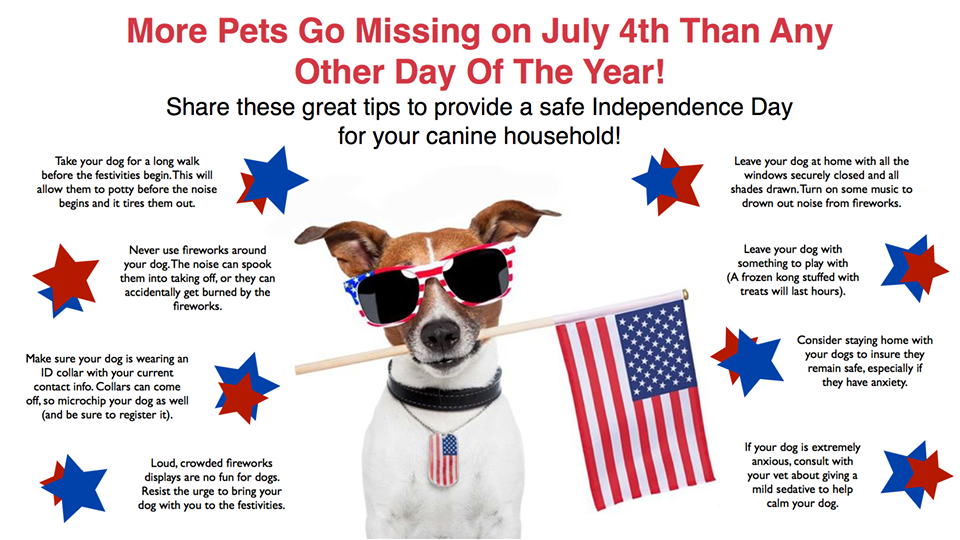
There will plenty of patriotic parades throughout Southern California this Independence Day, so check your local city calendar to see if your city will be hosting a parade this year.  And remember that fireworks can be very upsetting for a dog, so please leave them at home for the fireworks.  Have a safe and fun 4th of July!  


FIREWORKS ALERT! Before you leave for the night to enjoy fireworks, make sure your dog is taken care of.  Most, if not all dogs, hate loud and startling noises; and fireworks are at the top of that list.  Fireworks can make the perfect dog turn into the most neurotic dog you’ve ever seen.  To help keep your dog’s sanity and your property in tack I suggest the following:  

1.       Make sure your dog is inside the house before leaving for the night.  If you have an outside dog, then put them in the garage (after the sun goes down so they don’t suffer a heat stoke).  If your dog is allowed inside the house, put them in a room furthest from where you think the firework noise will be coming from (for example, if the fireworks show is at a local school just east of your house then put your dog in the furthest room to the west).

2.       Turn on soothing music.  Classical music is best in my opinion, but anything will do as long as it isn’t angry or harsh music that would cause your dog further anxiety. (FYI: the classical FM station is 91.5). You don’t want to turn the volume all the way up, making your dog deaf or causing more anxiety, but make it loud enough to distract them from outside noises.


No matter what you decide to do this holiday weekend, please keep your dog’s health, happiness, and safety in mind.  Don’t become a statistic.  If you take them to the river, please remember that life jacket while on the water.  If you take them on a road trip, please remember that seat belt harness.  Lots of water, shade, and sun block will keep your dog happy and healthy as well.  Enjoy your Independence Day with your whole family, four-legged family members included!     

Tuesday, June 23, 2015

Take Your Dog to Work Day


This year, Take Your Dog to Work Day is this Friday, June 26th.  Take your dog to work day was first celebrated in 1999.  It was created by Pet Sitters International to celebrate great companion dogs and to help encourage their adoption. 
 
Want to participate by taking your dog to work this year? Here are a few tips to help make that day a success...

6 Basic Tips for making 'Take Your Dog to Work Day' work:

1. Do an Office Check
Check with bosses and co-workers to find out and address any potential problems with bringing dogs to the office.  Be respectful of allergies, fears, and objections. 

2. Puppy-Proof your Work Space
Any office items should be out of reach from your dog.  Also be sure to remove any poisonous plants, hide electrical cords/wires, and secure any toxic items and hazardous products.

3. Be Sure Fido is Fit for Work
You only get 1 chance at a first impression.  So if you want to be able to bring your dog to work next year then you best put be ready to shine. Make sure your dog is current on vaccinations, freshly groomed, as well as friendly and sociable.  If your dog is aggressive, shy, or just not ready, that's alright. It's best to let them stay home. Maybe just bring your favorite picture of them instead.    

4. Prepare a Doggie Bag
You may want to bring items that will make your dog feel comfortable, as well as a few essentials.  You might pack food, treats, bowls, toys, a leash, paper towels, clean-up bags, and pet-safe disinfectant.  Also consider a portable crate and baby gate for your work space; for your dog's comfort and your peace of mind. 

5. Plan Feeding Times Carefully
If you are going to feed your dog while at work, plan your dog's feeding time around your work schedule to ensure a good time for potty breaks.  And choose an appropriate area for your dog to relieve himself. 

6. Avoid Forcing Co-workers to Interact with your Dog
Some co-workers may not want to meet or play with your dog.  So, be mindful and respectful of their space and time.   Also, monitor the amount and type of treats co-workers give to your dog.  Too many dog treats or consumption of human treats (like chocolate and candy) are likely to make your dog sick. 


4 Rules All Participants Should Adhere to:
 
1. Dogs should be kept on leash whenever outside an employee's office or cubicle.
 
 
2. Participating employees should use a baby gate to prevent dogs from leaving their office space unattended.
 
 
3. Specific areas, such as the bathroom or dining hall, should be dog-free zones.

4. Participating employees should have a back-up plan for getting their dog home or out of the office if the dog is not comfortable being there.


3 Activity Ideas to Make the Day More Festive:
 
1. Pet Care "Lunch & Learn"
Invite a professional pet sitter, dog trainer, vet, etc. to give a pet-care presentation during lunch. 
 
2. Fido Fundraiser
Host a silent auction, pet photo contest, or hot dog luncheon and donate the proceeds to a local shelter or rescue organization. 
 
3. Canine Contest
Hold a Best Trick, Best Outfit, or even Pet/Owner Look-a-Like contest to add fun and increase interaction among participants. 
 
For more information or to help you start ‘Take your dog to work Day’ in your office, visit the official website and download the TYDTWDay Action Pack

Wednesday, May 20, 2015

Dog Bite Prevention Week


Did you know…
….more than 4.5 million Americans are bitten every year by a dog and 83% are children?
….50% of all U.S. children will be bitten by a dog before their 12th birthday?
….Each year 800,000 bite injuries are severe enough to require medical attention?
….If you Google “Orange County dog bite prevention” you will get pages of attorneys and law offices ready to sue for dog bite injuries?

Whether you own a dog or not, these statistics affect you in one way or another. They also point out one major problem in the U.S. and it is a lack of dog bite prevention education and responsible dog ownership.

To raise awareness for this perpetual public health problem, the U.S. Postal Service and the American Veterinary Medical Association (AVMA) joined forces along with other organizations to promote National Dog Bite Prevention Week during the third week of May each year.  And although this week has brought about an increase in awareness, there are still dog bites happening every day, which only demonstrate the need for greater awareness and education efforts nationwide.

The beginning of your basic education must first start with some sort of understanding of dogs.
“Even the gentlest dog, if it is physically or mentally unhealthy, is in pain, feels threatened, or is protecting its food or a favorite toy, can bite,” Dr. Gail C. Golab, director of the AVMA’s Animal Welfare Division said. “Not only is it important to understand how dogs behave, it is important to understand how our behavior may be interpreted by a dog. To prevent dog bites, we need to find a common language. Finding that common language is the focus of effective dog bite prevention educational efforts.”


According to the ASPCA, “The vast majority of dog bites are from a dog known to the child—his or her own pet, a neighbor's or friends.” A common misconception among people is that because they are around a certain dog a lot they assume that dog must like and feel comfortable around them. But dogs have their own rules of etiquette and they give lots of body language they people don't pick up on, which leads to an "out of the blue" dog bite.  And because children are so close to the dog’s size, their bites are usually worse on the face or neck.  


Dog bites are a problem for children and adults alike. So what can you do to avoid being bitten by the next dog you encounter?

The Proper Way to greet a dog

When meeting or greeting an unfamiliar dog, first ask the owner if the dog is friendly and then ask for permission to pet the dog.  You should then ask the dog for permission to pet him or her but letting the dog sniff the back of your hand before petting the animal. Always pet a new dog under the chin, on the shoulder, or on the chest, but never on their head first.  A dog may misinterpret a person leaning over them as a dominant behavior and feel threatened.
Here are basic tips put together by the U.S. Postal Service and the ASPCA to avoid being bitten by a dog:
·         Don’t run past or away from a dog. The dog’s natural instinct is to chase and catch prey. 
·         If a dog threatens you, don’t scream. Avoid eye contact because dogs interpret this as a challenge. Try to remain motionless until the dog leaves, then back away slowly until the dog is out of sight.
·         Don’t approach a strange dog, especially one that’s tethered or confined.
·         Do not tease a dog behind a fence or tethered in a yard.
·         Do not touch or play with a dog that is eating or sleeping.  

·         If you believe a dog is about to attack you, try to place something between yourself and the dog, such as a backpack or a bicycle. Otherwise, you should stand still “Like a tree trunk” with your arms crossed over your chest (closed fists). If you or your child should fall to the ground, you should curl into a ball, with your knees to your chest and your fingers interlocked covering the back of your neck. If you stay still, the dog will most likely sniff you, loose interest and leave you alone. 

A great tool for children, and adults alike, is this educational video produced by the AKC to help kids avoid being bitten by a dog.  I highly recommend all parents watch this video with their kids and encourage your schools to show the video to each class as well. Education has to start with children not only to stop kids for getting bitten but to plant a seed for future responsible pet owners that will break the cycle. Check out the AKC website to view the video or to order a free copy for your school or community group. They also provide a workbook for kids to go over after the video to ensure they understood what they learned.