Friday, August 14, 2015

13 Weeks of Summer: Week 8


Even though school is starting back again, and it may seem like summer is over, it is not. You still have long summer days to enjoy adventures with your dog.  

Week 8: Get Prepping

Ever heard of SCART - SoCal Animal Response Team? SCART is an organization that responds to animal needs and assist other agencies during a disaster or crisis. They also work to educate the public on disaster preparedness and animal abuse.  This Saturday, August 15th, SCART is hosting their 10thAnnual Pet Fair; an Emergency Preparedness Fair for Pets and People. This event will host several disaster information vendors, food trucks, and raffles. And while they ask that you have your pets stay home for this event, you can still attend the fair, get the useful information, and then return home to get prepared with the help of your dog.  

Ways to let your dog help you get prepared:

1.       Put an emergency pack together (one for humans and one for pets).  This may require a special trip to the dog store, which your dog would love.
2.       Come up with an emergency evacuation plan that includes a couple of safe places.  Safe places may include a boarding facility for your dog (in case you have to go to a shelter that doesn’t allow pets), a friend or family member in another city, and a dog-friendly hotel in another city, county or even state.

3.       Practice that emergency evacuation with your dog.  The more familiar he/she is with your escape route, the easier it will be to evacuate in a stressful situation. 

Thursday, July 16, 2015

Summer Concert Series


If it’s too hot to enjoy the day with your pup, spend an evening with him or her instead.  Most cities have summer concert series in the park as well as a few family movie nights.  Not all music line ups are the same.  From classical to classic rock, country and more; you and your pup are bound to find music that you enjoy.

Nearly every city in SoCal has a summer concert series from now through August.  Buena Park, Corona, Fullerton, Huntington Beach, Newport Beach, Orange, Riverside, and Tustin (just to name a few) have concerts on various nights of the week, and admission is free.

This month you can catch Symphonic winds of the Pacific (Pops & Patriotic) or The Fenians (Celtic Rock) in concert at the Brea City Hall Park, on a Wednesday night. 

Or Perhaps you want to watch Memphis Kings featuring Kid Ramos (Rockabilly) or Woodies and the Longboards (Beach Boys Tribute) in Fullerton on a Wednesday night.  

In Placentia you can see Upstream (Reggae, Calypso) or Mariachi Divas (Award Winning Female Ensemble) on a Thursday night at the Tri-City Park. 

The city of Orange will be hosting bands like Knyght Ryder (80’s Flashback) and Smokin’ Cobras (Rocking Oldies) at the Hart Park Bandshell on Wednesday nights. 

And Anaheim will be hosting tribute bands all month (U2, Journey, Fleetwood Mac) at the Ronald Reagan Park in Anaheim Hills on Thursday nights. 

There are different bands every week, and some bands play in multiple cities, so check your city for a free summer concert series or attend one of the shows mentioned above.  And if you missed a band you wanted to see, check other cities to see if they are playing on another night.

When you go, don’t forget a blanket and or lawn chair for you and your pup to sit on.  And most importantly, don’t forget your petiquette while enjoying the concert.  Remind your pup to be on his best doggy behavior at all times.  Keep him on his leash, be sure to pick up any messes he leaves, and bring plenty of fresh water for him.  


Wednesday, July 1, 2015

4th of July with your Dog


The second week of summer happens to host the 4th of July, which makes attending a 4th of July parade an excellent activity.

Enjoy the festivities of 4th of July this year in Anaheim Hills, with the Firecracker 5k/10k Run, a pancake breakfast, a Yankee Doodle Dog show, a parade, and then fun in the park. The day is filled with 4th of July fun, which you can enjoy with your dog, including their annual parade as it marches down Santa Ana Canyon Blvd. at 1 p.m. 

Orange Park Acres (in Orange Hills) is hosting a 5k Walk/Run Race & 10k Epic Challenge Cross-Country Race, followed by a parade. The day begins at 6:45 a.m., and the Parade will begin at 9:30 a.m. 

The Huntington Beach 4thof July Parade is said to be “the largest Independence Day parade west of the Mississippi River” with more than 300 entries, from bands and floats to celebrities and community groups.  The parade starts at 10 a.m. at the intersection of Main Street and Pacific Coast Highway and will end at Main Street and Yorktown Avenue.  

The Newport Beach Harbor OldGlory Boat Parade is a festive spectacle of boats, decorated in red, white, and blue, cruising around the harbor.  The fun filled day begins at 7 a.m. with a pancake breakfast, followed by a buffet lunch, dancing, the boat parade, and fireworks. The boat parade starts at 2:30 p.m.

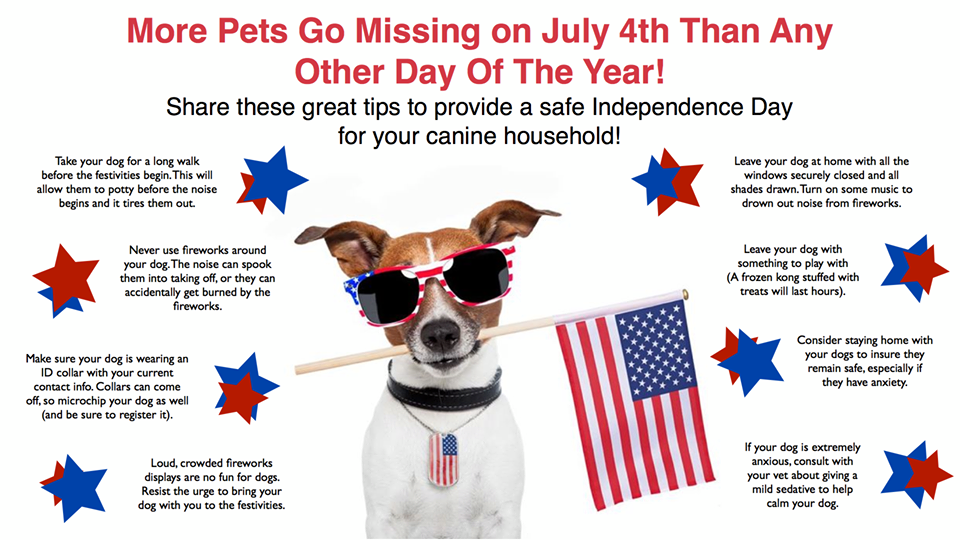
There will plenty of patriotic parades throughout Southern California this Independence Day, so check your local city calendar to see if your city will be hosting a parade this year.  And remember that fireworks can be very upsetting for a dog, so please leave them at home for the fireworks.  Have a safe and fun 4th of July!  


FIREWORKS ALERT! Before you leave for the night to enjoy fireworks, make sure your dog is taken care of.  Most, if not all dogs, hate loud and startling noises; and fireworks are at the top of that list.  Fireworks can make the perfect dog turn into the most neurotic dog you’ve ever seen.  To help keep your dog’s sanity and your property in tack I suggest the following:  

1.       Make sure your dog is inside the house before leaving for the night.  If you have an outside dog, then put them in the garage (after the sun goes down so they don’t suffer a heat stoke).  If your dog is allowed inside the house, put them in a room furthest from where you think the firework noise will be coming from (for example, if the fireworks show is at a local school just east of your house then put your dog in the furthest room to the west).

2.       Turn on soothing music.  Classical music is best in my opinion, but anything will do as long as it isn’t angry or harsh music that would cause your dog further anxiety. (FYI: the classical FM station is 91.5). You don’t want to turn the volume all the way up, making your dog deaf or causing more anxiety, but make it loud enough to distract them from outside noises.


No matter what you decide to do this holiday weekend, please keep your dog’s health, happiness, and safety in mind.  Don’t become a statistic.  If you take them to the river, please remember that life jacket while on the water.  If you take them on a road trip, please remember that seat belt harness.  Lots of water, shade, and sun block will keep your dog happy and healthy as well.  Enjoy your Independence Day with your whole family, four-legged family members included!     

Tuesday, June 23, 2015

Take Your Dog to Work Day


This year, Take Your Dog to Work Day is this Friday, June 26th.  Take your dog to work day was first celebrated in 1999.  It was created by Pet Sitters International to celebrate great companion dogs and to help encourage their adoption. 
 
Want to participate by taking your dog to work this year? Here are a few tips to help make that day a success...

6 Basic Tips for making 'Take Your Dog to Work Day' work:

1. Do an Office Check
Check with bosses and co-workers to find out and address any potential problems with bringing dogs to the office.  Be respectful of allergies, fears, and objections. 

2. Puppy-Proof your Work Space
Any office items should be out of reach from your dog.  Also be sure to remove any poisonous plants, hide electrical cords/wires, and secure any toxic items and hazardous products.

3. Be Sure Fido is Fit for Work
You only get 1 chance at a first impression.  So if you want to be able to bring your dog to work next year then you best put be ready to shine. Make sure your dog is current on vaccinations, freshly groomed, as well as friendly and sociable.  If your dog is aggressive, shy, or just not ready, that's alright. It's best to let them stay home. Maybe just bring your favorite picture of them instead.    

4. Prepare a Doggie Bag
You may want to bring items that will make your dog feel comfortable, as well as a few essentials.  You might pack food, treats, bowls, toys, a leash, paper towels, clean-up bags, and pet-safe disinfectant.  Also consider a portable crate and baby gate for your work space; for your dog's comfort and your peace of mind. 

5. Plan Feeding Times Carefully
If you are going to feed your dog while at work, plan your dog's feeding time around your work schedule to ensure a good time for potty breaks.  And choose an appropriate area for your dog to relieve himself. 

6. Avoid Forcing Co-workers to Interact with your Dog
Some co-workers may not want to meet or play with your dog.  So, be mindful and respectful of their space and time.   Also, monitor the amount and type of treats co-workers give to your dog.  Too many dog treats or consumption of human treats (like chocolate and candy) are likely to make your dog sick. 


4 Rules All Participants Should Adhere to:
 
1. Dogs should be kept on leash whenever outside an employee's office or cubicle.
 
 
2. Participating employees should use a baby gate to prevent dogs from leaving their office space unattended.
 
 
3. Specific areas, such as the bathroom or dining hall, should be dog-free zones.

4. Participating employees should have a back-up plan for getting their dog home or out of the office if the dog is not comfortable being there.


3 Activity Ideas to Make the Day More Festive:
 
1. Pet Care "Lunch & Learn"
Invite a professional pet sitter, dog trainer, vet, etc. to give a pet-care presentation during lunch. 
 
2. Fido Fundraiser
Host a silent auction, pet photo contest, or hot dog luncheon and donate the proceeds to a local shelter or rescue organization. 
 
3. Canine Contest
Hold a Best Trick, Best Outfit, or even Pet/Owner Look-a-Like contest to add fun and increase interaction among participants. 
 
For more information or to help you start ‘Take your dog to work Day’ in your office, visit the official website and download the TYDTWDay Action Pack. 

Wednesday, May 20, 2015

Dog Bite Prevention Week


Did you know…
….more than 4.5 million Americans are bitten every year by a dog and 83% are children?
….50% of all U.S. children will be bitten by a dog before their 12th birthday?
….Each year 800,000 bite injuries are severe enough to require medical attention?
….If you Google “Orange County dog bite prevention” you will get pages of attorneys and law offices ready to sue for dog bite injuries?

Whether you own a dog or not, these statistics affect you in one way or another. They also point out one major problem in the U.S. and it is a lack of dog bite prevention education and responsible dog ownership.

To raise awareness for this perpetual public health problem, the U.S. Postal Service and the American Veterinary Medical Association (AVMA) joined forces along with other organizations to promote National Dog Bite Prevention Week during the third week of May each year.  And although this week has brought about an increase in awareness, there are still dog bites happening every day, which only demonstrate the need for greater awareness and education efforts nationwide.

The beginning of your basic education must first start with some sort of understanding of dogs.
“Even the gentlest dog, if it is physically or mentally unhealthy, is in pain, feels threatened, or is protecting its food or a favorite toy, can bite,” Dr. Gail C. Golab, director of the AVMA’s Animal Welfare Division said. “Not only is it important to understand how dogs behave, it is important to understand how our behavior may be interpreted by a dog. To prevent dog bites, we need to find a common language. Finding that common language is the focus of effective dog bite prevention educational efforts.”


According to the ASPCA, “The vast majority of dog bites are from a dog known to the child—his or her own pet, a neighbor's or friends.” A common misconception among people is that because they are around a certain dog a lot they assume that dog must like and feel comfortable around them. But dogs have their own rules of etiquette and they give lots of body language they people don't pick up on, which leads to an "out of the blue" dog bite.  And because children are so close to the dog’s size, their bites are usually worse on the face or neck.  


Dog bites are a problem for children and adults alike. So what can you do to avoid being bitten by the next dog you encounter?

The Proper Way to greet a dog

When meeting or greeting an unfamiliar dog, first ask the owner if the dog is friendly and then ask for permission to pet the dog.  You should then ask the dog for permission to pet him or her but letting the dog sniff the back of your hand before petting the animal. Always pet a new dog under the chin, on the shoulder, or on the chest, but never on their head first.  A dog may misinterpret a person leaning over them as a dominant behavior and feel threatened.
Here are basic tips put together by the U.S. Postal Service and the ASPCA to avoid being bitten by a dog:
·         Don’t run past or away from a dog. The dog’s natural instinct is to chase and catch prey. 
·         If a dog threatens you, don’t scream. Avoid eye contact because dogs interpret this as a challenge. Try to remain motionless until the dog leaves, then back away slowly until the dog is out of sight.
·         Don’t approach a strange dog, especially one that’s tethered or confined.
·         Do not tease a dog behind a fence or tethered in a yard.
·         Do not touch or play with a dog that is eating or sleeping.  

·         If you believe a dog is about to attack you, try to place something between yourself and the dog, such as a backpack or a bicycle. Otherwise, you should stand still “Like a tree trunk” with your arms crossed over your chest (closed fists). If you or your child should fall to the ground, you should curl into a ball, with your knees to your chest and your fingers interlocked covering the back of your neck. If you stay still, the dog will most likely sniff you, loose interest and leave you alone. 

A great tool for children, and adults alike, is this educational video produced by the AKC to help kids avoid being bitten by a dog.  I highly recommend all parents watch this video with their kids and encourage your schools to show the video to each class as well. Education has to start with children not only to stop kids for getting bitten but to plant a seed for future responsible pet owners that will break the cycle. Check out the AKC website to view the video or to order a free copy for your school or community group. They also provide a workbook for kids to go over after the video to ensure they understood what they learned. 


Thursday, May 14, 2015

Is your Dog and Home Armed Against Fleas and Ticks?


It's Springtime and like every year, as temperatures start to warm up, the bugs start to come out and reproduce.  What does this mean for your dog? It means a heightened exposure to ticks, fleas, and other parasites; especially when spring is a peak season for deer ticks.

The dangers of fleas

The Small Animal Hospital in Riverside gives a little light on Understanding the Flea and says, “When a flea bites your dog, it injects a small amount of saliva into the skin to prevent blood coagulation. Some animals may have fleas without showing discomfort, but an unfortunate number of dogs become sensitized to this saliva. In highly allergic animals, the bite of a single flea can cause severe itching and scratching. Fleas cause the most common skin disease of dogs – flea allergy dermatitis.” – Dr. Doug Brum.    

Symptoms of flea allergy dermatitis (FAD) include redness, bumps, scabs, and severe hair loss due to scratching.  Fleas can also carry tapeworm, as they are a main host for the parasite.  If your dog ingests a flea they might also be ingesting a tapeworm, which can be hard to detect because they show few symptoms.  Taking the steps to keep your dog flea free will prevent a lot of trouble down the road.

The dangers of ticks

Ticks can also cause medical problems for your dog because they can transmit serious diseases such as Lyme disease, Ehrlichiosis and Rocky Mountain spotted fever. 
“It is not the tick bite but the toxins, secretions, or organisms in the tick's saliva transmitted through the bite that causes disease.” – Charles P. Davis, M.D., Ph.D.  When ticks feed they bury their teeth deep into the skin of their host.  In addition, the blood in their stomach is poisonous.  For these reasons, it is very important that ticks are removed carefully and in one piece.  If the head of a tick is left in the skin, your dog can still contract a disease.  If the tick body is opened and blood is released into the open wound of your dog it can cause a skin infection. 
Signs of a tick bite on your dog include fever, loss of appetite, sore and swollen limbs, skin infections, lethargy, and arthritis.  Both ticks and fleas can cause Anemia (low blood count) in a dog from losing too much blood.
Because the signs of a tick bite can be commonly mistaken for another issue, it is best to check over your dog anytime they have been exploring outside or in an area that might carry ticks.  Ticks often look like a large brown flea, but have eight legs like a spider.  They bite into your dog and feed on his blood, and like a mosquito, they get bigger as they feed. By running your hand over your dog’s coat, you would feel a strange bump if a tick is attached.  Check inside your dogs ears as well since ticks can easily hide in there.  By checking your dog as soon as you come in from outside you are increasing your chances of catching a tick on your dogs coat before they have attached themselves.  
Remember, ticks do bite humans too, so preventing your dog from attracting a tick is a preventative measure for the whole family.  

Now that you know the threat that fleas and ticks pose, what do you do to keep your dog safe from these pesky parasites?  Do you wait until Fido has a patch of fur missing on his rump?  Well, if you want to shell out a hundred bucks or so for blood work, a cortisone shot, and some antibiotics to take home from the vet, then sure.  But if you’re a responsible pet owner, as I’m sure all of you are, then you know prevention is key!  


Ways to protect your home and your dog from fleas and ticks

Outside- Bugs do not know the difference of a zip code.  Whether you live in the populous downtown area or back in the hills where your closest neighbor is a five minute drive away, fleas and ticks can find you.  They can live in bushes, tall grass, and crawl spaces (to name a few) and they can get there without your dog ever leaving your property.  You can protect your yard by:
·         Having regular bug control service, such as Terminix or Orkin, spray the perimeter of your house and areas of the yard. 
·         Buying a bottle of flea and tick yard spray that you can attach to your hose and spray the areas in your yard that your dog likes to be.   This yard spray can be purchased at most pet retail stores, feed stores, some veterinarian offices, and online.

Inside- All it takes is one flea or tick to make it in the house and lay eggs for you to have a problem.  And this doesn’t only happen in dirty houses, it can happen in the cleanest houses as well.  If you leave the problem unattended then it becomes a bigger problem and before you know it, you are ankle deep in a swarm of fleas. You can protect the inside of your home by:
·         Using a flea and tick spray (on carpet or upholstery) that will kill all pests and their eggs.
·         Using a home fogger that will kill all pests and their eggs for several months.
o   (Check out HartzHome Spray and 4 in 1 Home Fogger)
·         Vacuuming regularly will pick up all pests and their eggs but be sure to either use a flea powder on the carpet first or throw away the vacuum bag right away; otherwise it is just an incubator for the eggs, causing a larger problem.

Your dog- Making sure your dog is protected is your safest bet when fighting fleas and ticks.  You can protect your dog by:
·         Grooming him/her regularly (ie. Bath, brush, ear cleaning). You can even use flea shampoo or a flea comb to be more thorough.
·         Getting a flea dip
·         Using a heartworm preventative
·         Using a flea/tick preventative (flea/tick medicine or a flea collar)
·         Dietary changes (for this and other natural bug repellent ideas, check out Paw-rescue.org) 


Keep your dog safe and happy this spring and all year long by incorporating these preventative measures in your home.


Tuesday, May 5, 2015

Its Easy to Be Kind to Animals


A little known fact about the first week of May is that although it is a time to celebrate Cinco de Mayo and Mother's Day, it is also National Pet Week and Be Kind to Animals Week. While we are easily kind to our own pets, do we overlook or take for granted the other animals in our area (or around the world)?

From the beginning of time, animals have been enriching our lives, whether we realize it or not.  From bees to killer whales, animals keep our world in balance on a daily basis by doing things that we often see as insignificant, and we take for granted their important contributions.  We even tend to take for granted the animal that has the largest impact in our lives, supplying us with unconditional love regardless of our flaws - our dogs.  

This first week in May has been set aside for us to notice these contributions and to say “Thank you” for them by changing our own habits and implementing ways to be kind to animals.

Here are 10 easy things you can start doing in your life to show a little kindness to not only your own pets, but to animals all over the world.

1.  Plant trees, shrubs, or flowers in your yard to make birds and other wildlife feel welcome.

2. Put out a bird feeder, bird house, or bird bath in your yard.  You can get the kids involved by building a bird house together or by letting them help you fill the bird feeder regularly.

3. Adopt a shelter pet, donate to an animal shelter, or volunteer at an animal shelter.  Sometimes help comes in different ways, and ensuring animals are cared for while waiting for a new home can make a world of different to an animal.

4.  Keep your dogs (and cats) vaccinated and take them for regular check-ups to prevent illness.

5. Keep up with your dog’s hygiene regularly by brushing their teeth, cleaning their ears, bathing them, trimming their nails, brushing their coats, and expressing their anal glands (if needed). Groom your dog regularly to ensure their coat/skin is healthy, check for fleas and ticks, and to help your dog keep cool in the summer.    

6. Spend quality time with your dog daily.  There’s no better way to show your dog some love than by giving him regular exercise, but dogs also love a good massage.

7. Never tolerate animal cruelty.  If you see an animal being abused, report it immediately.

8. Recycle as often as you can to reduce the amount of waste that goes to landfills and pollutes the ocean.  This includes properly disposing of old antifreeze or other toxins and cutting up all nets and 6-pack plastic rings to make sure animals don’t ingest or get caught in such hazardous waste. Also try using reusable bags when shopping, instead of plastic.   

9. Leave all wild animals (and their homes) in their natural environment (insects, lizards, and sea creatures included).

10. Educate others about the importance of kindness to animals. 
Parents- teach your kids though books, wildlife shows/movies, and by example.  
Kids- teach your peers by using animal issues as topics for school projects and book reports and by always showing a good example. 
Everyone- Pass on your belief in animal kindness to your co-workers, neighbors, family, and friends and always show a good example.


“We speak for those who cannot speak for themselves.” – G.T. Angell